Evaluating Bubble Bloom: A Practical Guide to Its Design, Utility, and Best Use Cases
In the realm of digital typography for creative projects, selecting the right typeface is often a balancing act between aesthetic appeal and functional versatility. Bubble Bloom has emerged as a significant option for designers, crafters, and small business owners seeking a specific visual tone. Characterized by its rounded, playful letterforms, this font aims to inject a sense of joy and energy into various media. However, before integrating it into a workflow, it is essential to understand its technical specifications, how it compares to broader categories of display fonts, and the specific scenarios where it delivers the most value.
Defining the Aesthetic and Technical Structure of Bubble Bloom
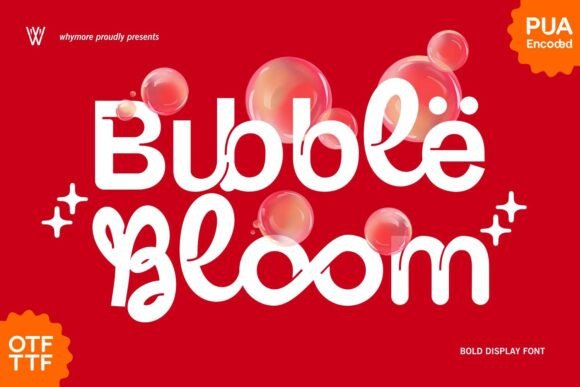
Bubble Bloom is not merely a decorative script; it is a structured display typeface designed with distinct geometric properties. The defining characteristic of this font is its "bubbly" architecture. Unlike traditional serif or sans-serif fonts that prioritize legibility at small sizes, Bubble Bloom prioritizes personality. The letterforms are heavily rounded, avoiding sharp angles in favor of soft curves that mimic the appearance of inflated shapes or organic forms. This design choice immediately signals a lighthearted, approachable, and fun mood to the viewer.
From a technical standpoint, a critical feature of Bubble Bloom is its PUA (Private Use Area) encoding. For those unfamiliar with this specification, PUA encoding allows the font to include special characters, ligatures, or alternate glyphs that do not exist in standard Unicode sets. In practical terms, this means the font can offer unique stylistic variations—such as extra-large bubbles, connecting elements, or decorative flourishes—that are accessible directly within compatible software without requiring manual image editing. This encoding is particularly relevant for users working with cutting machines like Cricut or Silhouette, where vector integrity and specific character mapping are crucial for clean cuts and precise vinyl application.
Comparing Bubble Bloom to Standard Display Fonts
When evaluating typography options, it is helpful to categorize fonts based on their intended emotional impact and structural rigidity. Bubble Bloom sits firmly in the category of "bubble" or "balloon" style fonts, but it distinguishes itself through its specific rendering of weight and spacing. Compared to standard rounded sans-serifs, which maintain a uniform stroke width and high readability, Bubble Bloom varies its stroke thickness to create a more hand-drawn, whimsical feel. This makes it less suitable for body text but highly effective for headlines and short phrases.
Another point of comparison lies in the level of customization. Many modern display fonts rely on OpenType features to provide alternates, whereas Bubble Bloom utilizes PUA encoding to achieve similar results. While OpenType is widely supported across all operating systems and web browsers, PUA-encoded fonts require specific software support to render correctly. For a professional designer working in Adobe Illustrator or InDesign, this may present a minor hurdle if the software does not natively map the private use area characters without configuration. Conversely, for hobbyists using dedicated crafting software, the PUA structure is often pre-optimized, making the font "plug-and-play" ready. This distinction is a vital decision factor when choosing between Bubble Bloom and other alternatives that might rely on standard OpenType ligatures.
Strengths and Tradeoffs in Digital and Physical Media
The strengths of Bubble Bloom are most evident in applications where visual engagement is paramount over information density. Its bold, rounded shapes command attention, making it an excellent choice for social media posts where stopping power is necessary to break through content fatigue. Similarly, in physical media such as product packaging or stickers, the font's thick lines ensure visibility even from a distance. The "splash of fun" it adds is immediate, aligning well with brands targeting younger demographics or those wishing to project a friendly, non-corporate identity.
However, there are tradeoffs to consider. The very features that make the font distinctive can limit its scalability. Because the letterforms are complex and filled with curvature, they may lose definition when scaled down to very small sizes, such as fine print on a label or legal disclaimers. Additionally, the dense nature of the bubbles can lead to legibility issues in long paragraphs. Therefore, Bubble Bloom should be treated strictly as a display font. Attempting to use it for extended reading material would likely result in reader fatigue and a perceived lack of professionalism.
Ideal Applications and Contextual Fit
Understanding where Bubble Bloom fits best requires looking at the end goal of the project. It excels in environments that celebrate creativity, childhood, and celebration. For instance, in the creation of kids' T-shirts and apparel, the font's energetic vibe complements colorful graphics and cartoon illustrations. It reinforces the playful nature of the garment without needing additional explanation.
In the realm of event planning, birthday invitations and party signage benefit significantly from this typeface. The rounded edges soften the invitation, making it feel warm and welcoming. When paired with bright colors and confetti-style graphics, Bubble Bloom creates a cohesive theme that resonates with guests. Furthermore, for scrapbook enthusiasts, the font serves as an ideal tool for titles and planner headers. Its distinct shape helps separate different sections of a layout, acting as a visual anchor that draws the eye to key memories or dates.
For small business owners focusing on handmade goods, Bubble Bloom offers a cost-effective way to elevate branding. It is frequently used for crafty quotes on vinyl decals and product labels. The PUA encoding ensures that when these designs are cut on vinyl, the intricate details remain intact, preventing the common issue of thin lines breaking during the weeding process. This reliability makes it a preferred choice over thinner, more delicate scripts that might fail under the stress of a cutting blade.
Decision Factors: When to Choose Alternatives
While Bubble Bloom is versatile within its niche, it is not a universal solution. Readers should consider alternative typefaces if their project demands formal authority, minimalism, or high-density text. If the goal is to convey trust, stability, or corporate seriousness, a clean sans-serif or a traditional serif font would be more appropriate. The playful nature of Bubble Bloom could undermine the message in contexts such as financial reports, medical communications, or luxury branding where subtlety is valued over exuberance.
Additionally, the compatibility of the font with existing workflows is a critical decision factor. If a user primarily works in a web environment or needs the font to render perfectly across all devices without custom CSS mapping, a standard OpenType font might be a safer bet. The PUA encoding of Bubble Bloom, while powerful for crafting software, can sometimes cause display inconsistencies on the open web unless handled with care. Therefore, for purely digital marketing campaigns that rely heavily on responsive web design, one might evaluate whether the technical setup justifies the aesthetic benefits.
Conclusion on Strategic Typography Selection
Selecting the right font is rarely about finding the "best" option in a vacuum; it is about finding the right fit for a specific context. Bubble Bloom offers a robust solution for projects requiring a joyful, rounded, and engaging aesthetic, particularly in crafting, children's themes, and casual branding. Its PUA encoding provides unique advantages for vinyl cutting and specialized design software, ensuring high-quality output for physical products. However, its limitations regarding legibility at small sizes and its informal tone mean it should be used strategically rather than indiscriminately. By weighing these factors against project requirements, designers and creators can determine if Bubble Bloom is the optimal tool for their next endeavor or if a different typographic approach better serves their goals.