Shock Value: A Review of the Unhinged Expressionist Display Font
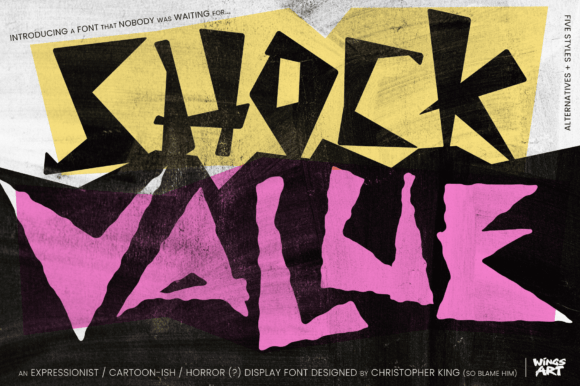
In the crowded landscape of digital typography, most designers seek harmony, legibility, and subtle sophistication. However, there is a distinct niche for assets that deliberately disrupt these norms. Shock Value is not a typeface designed to blend in; it is an aggressive, chaotic display font born from a "misguided experiment" with triangular shapes. What began as a playful exploration of geometry evolved into a visual style that channels the jagged tension of German Expressionist cinema, the erratic energy of 90s cartoons, and the visceral unease of horror aesthetics. For professionals seeking a tool that feels like a "cold slap in the face with a fish," this font offers a unique, albeit limited, utility.
The Visual Language of Chaos and Geometry
At its core, Shock Value is defined by its refusal to adhere to traditional typographic rules. The design relies heavily on sharp angles and triangular motifs, creating a silhouette that is instantly recognizable and inherently unstable. Unlike standard grotesque or serif fonts that prioritize optical balance, this typeface embraces asymmetry. The letterforms appear hand-drawn yet constructed with a rigid, almost mechanical precision that creates a jarring contrast.
This aesthetic draws directly from the visual vocabulary of early 20th-century German Expressionism. Think of the distorted sets in films like The Cabinet of Dr. Caligari, where reality is warped to reflect psychological turmoil. Shock Value translates this cinematic language into static text. When paired with the frenetic line work characteristic of 1990s animation—where characters were often drawn with exaggerated proportions and loose lines—the font achieves a sense of movement even when stationary. It suggests a narrative of instability, making it a potent choice for projects requiring an immediate emotional reaction rather than passive reading.
Key Characteristics and Design Elements
- Triangular Dominance: The primary geometric structure relies on acute angles, avoiding curves in favor of spikes and points.
- Expressionist Distortion: Letter heights and widths vary unpredictably, mimicking the feeling of looking at something through a funhouse mirror.
- Cartoonish Aggression: The stroke weight fluctuates, giving the impression of a hurried, energetic hand-drawing process.
- Horror Undertones: The overall composition evokes a sense of dread or unease, suitable for darker thematic content.
Practical Applications and Real-World Performance
Evaluating a display font like Shock Value requires shifting the metric of success from readability to impact. This typeface is strictly intended for headlines, logos, short phrases, or cover art. Attempting to use it for body copy would be a functional failure; the irregular kerning and aggressive shapes make sustained reading difficult and fatiguing. However, within its intended scope, its performance is exceptional for specific use cases.
For marketers and creatives working in the entertainment sector, particularly in independent film, music festivals, or alternative publishing, this font serves as a powerful attention-grabber. Imagine a poster for an avant-garde theater production or a merchandise drop for an underground punk band. In these contexts, the font's "unhinged" quality aligns perfectly with the brand identity. It signals to the audience that the content is irreverent, experimental, and unafraid to break conventions.
The practical value of Shock Value lies in its ability to convey tone instantly. In a sea of clean, minimalist sans-serifs, this font cuts through the noise. It acts as a visual exclamation point, demanding immediate engagement. For entrepreneurs launching a product that needs to stand out as quirky or rebellious, using this typeface can differentiate the brand from competitors who rely on safe, corporate aesthetics.
Strengths in Creative Workflows
- Immediate Atmosphere: Sets a mood of chaos or suspense without needing additional imagery.
- Niche Appeal: Resonates strongly with audiences who appreciate retro-futurism, surrealism, or cult media.
- Versatility in Pairing: Works well when contrasted against highly structured, grid-based layouts, enhancing the sense of disruption.
Limitations and Usability Considerations
While Shock Value is effective for its specific purpose, it is crucial to acknowledge its limitations before integrating it into a project. The font's appeal is undeniably limited; it is not a universal solution. Its aggressive nature can alienate audiences if used inappropriately. For instance, applying this font to a financial report, a medical website, or a children's educational app would likely undermine credibility and confuse the user base.
From a technical standpoint, the font's consistency is intentionally low. While this is a stylistic choice, it can present challenges in responsive web design. On smaller screens, the intricate details and sharp angles may render poorly, causing the text to look muddy or illegible. Designers must test the font across various devices and resolutions to ensure the "hand-made" feel does not degrade into pixelated noise. Furthermore, the lack of standard character weights means that achieving hierarchy within the text itself is difficult; users cannot simply bold or italicize the text to create emphasis without breaking the design further.
Reliability in long-term branding is another factor to consider. Trends in typography shift, and while the expressionist and 90s cartoon revival has staying power, the extreme nature of Shock Value risks dating quickly. Brands aiming for longevity should use such fonts sparingly, perhaps for seasonal campaigns or specific product lines rather than as a core element of their permanent logo identity.
Who Should Use This Font?
This asset is best suited for a specific demographic of creators: graphic designers specializing in album covers, indie filmmakers, event organizers for niche festivals, and copywriters crafting edgy marketing campaigns. It appeals to those who understand that sometimes, the goal of communication is not clarity, but provocation. If your project requires a voice that sounds like it is shouting from the edge of a cliff, this font provides the necessary visual weight.
Conversely, small business owners in conservative industries, educators focusing on academic rigor, or publishers targeting mass-market fiction readers should likely avoid Shock Value. The font's inherent chaos can distract from the message rather than enhance it. It is a tool for the bold, not the cautious.
Final Verdict on Long-Term Value
Ultimately, Shock Value is a specialized instrument in the typographer's toolkit. It is not a font for everyday use, nor is it designed to be loved by everyone. Its value comes from its ability to deliver a precise, high-intensity emotional response. For projects that need to feel chaotic, unhinged, and distinctly hand-crafted, it performs its function admirably. It captures the spirit of a "misguided experiment" and turns it into a deliberate artistic statement.
When evaluating whether to include this font in your workflow, ask yourself if your project benefits from a "cold slap in the face." If the answer is yes, then Shock Value offers a unique, memorable, and professionally executed way to achieve that effect. Used with restraint and strategic intent, it can elevate a design from merely interesting to unforgettable. However, like any extreme tool, it demands respect for its boundaries. By understanding its strengths and acknowledging its limitations, designers can harness its wild energy to create work that truly stands apart in a saturated market.