Broken Tempo: A Quirky, Ugly Display Font for Retro Designs
In the crowded landscape of digital typography, where sleek sans-serifs and geometric grotesques dominate corporate interfaces, there is a distinct value in embracing imperfection. Broken Tempo is a display font that deliberately rejects modern polish in favor of a hand-drawn aesthetic inspired by vintage player-piano rolls. It is not designed to be invisible or strictly legible from a distance; rather, it is intended to stop the eye, evoke nostalgia, and inject a specific kind of offbeat rhythm into a visual hierarchy. For designers, marketers, and creators seeking to communicate personality over precision, this typeface offers a unique solution that bridges the gap between industrial history and contemporary graphic design.
The Origins and Aesthetic of Broken Tempo
To understand the utility of Broken Tempo, one must first appreciate its conceptual foundation. The font draws its inspiration directly from the perforated paper rolls used in early 20th-century mechanical pianos. These rolls were functional artifacts, yet they possessed an inherent visual charm defined by their irregular spacing, jagged edges, and the physical limitations of the machinery that created them. The designer has translated these mechanical quirks into a digital format, resulting in a typeface that feels tactile and organic despite being screen-based.
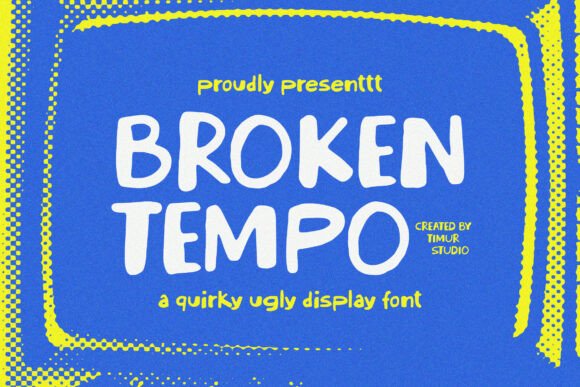
This "ugly" quality mentioned in its description is a deliberate stylistic choice. In typography, "ugly" often refers to a departure from classical proportions and perfect symmetry. Broken Tempo leans heavily into this territory. Its characters vary in weight, alignment, and form, mimicking the look of a roll that has been slightly damaged, hastily punched, or viewed through a grainy lens. This creates a sense of movement and energy, as if the letters themselves are vibrating with the music they represent. For projects requiring a touch of retro personality, this historical reference provides an immediate context that clean, modern fonts simply cannot achieve.
Key Characteristics and Visual Strengths
When evaluating the practical application of Broken Tempo, several key characteristics stand out. The most prominent is its variability. Unlike standard display fonts that maintain a consistent baseline and x-height, this typeface introduces playful irregularities. Letters may sit slightly higher or lower than their neighbors, and stroke widths fluctuate unpredictably. While this might seem chaotic at first glance, it serves a specific purpose: it breaks the monotony of rigid grids.
- Nostalgic Charm: The font immediately signals a connection to the past, making it ideal for themes involving vintage technology, jazz, blues, or mid-century Americana.
- Hand-Drawn Feel: Despite its digital nature, the font retains the warmth of human craftsmanship, which can make branding feel more approachable and authentic.
- High Impact: As a display font, it commands attention. Its irregular shapes create high contrast against solid backgrounds, ensuring headlines pop without needing additional graphical embellishments.
- Rhythmic Quality: True to its name, the spacing and kerning options allow designers to create a visual beat, reinforcing the musical heritage of the typeface.
These strengths make Broken Tempo particularly effective for short bursts of text. It excels when used for titles, logos, or call-to-action buttons where the goal is to capture interest quickly. The font's ability to convey emotion—specifically playfulness, eccentricity, and a love for the old school—is its primary asset. In a sea of minimalist designs, a headline set in this typeface acts as a visual anchor, grounding the viewer in a specific mood.
Real-World Performance and Usability
While the aesthetic appeal of Broken Tempo is clear, its performance in real-world scenarios requires a balanced assessment. As a display font, it is not intended for body copy. Attempting to use it for paragraphs of text would result in poor readability and visual fatigue. The irregularities that give the font its character become obstacles when the reader needs to process information quickly. Therefore, its usability is strictly confined to headings, subheads, and decorative elements.
In terms of flexibility, the font performs well within its designated scope. Designers can manipulate tracking (letter-spacing) significantly to either tighten the rhythm for a punchy effect or loosen it to emphasize the individual quirks of each character. However, consistency can be a challenge. Because the font is designed to look imperfect, maintaining a cohesive brand identity across different media requires careful curation. A logo using Broken Tempo might look fantastic on a poster but could struggle to remain legible on a small mobile screen or a social media avatar.
Reliability is another factor to consider. When working with client projects, especially those targeting conservative industries, the "ugly" aspect of this font can be polarizing. It demands confidence from the designer. Using it effectively requires a strong understanding of layout principles to ensure the chaos does not overwhelm the message. If paired correctly with a neutral, highly legible sans-serif for body text, Broken Tempo creates a dynamic tension that enhances the overall design. Without that balance, the project risks looking unfinished or amateurish.
Ideal Use Cases and Audience Fit
Who benefits most from incorporating Broken Tempo into their workflow? The font is particularly well-suited for creative professionals who need to differentiate their work from generic templates. Musicians and record labels will find it invaluable for album covers and tour posters, where the musical lineage of the typeface resonates with the content. Similarly, event organizers hosting retro-themed parties, festivals, or workshops can leverage its nostalgic vibe to set the tone immediately.
Small business owners in niche markets also stand to gain. Think of a craft brewery, a vintage clothing boutique, or a local coffee shop that prides itself on artisanal quality. These brands often rely on storytelling and atmosphere. A menu header or a storefront sign in Broken Tempo communicates a commitment to tradition and character that a standard font cannot. It suggests that the business values uniqueness and has a personality beyond mere commerce.
Furthermore, educators and publishers focusing on history, music theory, or art history may find this font useful for creating engaging educational materials. It can transform dry topics into visually stimulating experiences, capturing the attention of students who are accustomed to polished, corporate-style textbooks. For bloggers and content creators, it serves as an excellent tool for section headers that break up long-form content, adding visual variety and preventing reader burnout.
Limitations and Practical Considerations
Despite its strengths, Broken Tempo is not a universal solution. Its limitations are inherent to its design philosophy. First, accessibility is a concern. Individuals with dyslexia or other reading difficulties may find the irregular letterforms challenging to decipher. If your target audience includes a significant portion of people with visual impairments, caution is advised, or the font should be restricted to purely decorative uses where readability is not critical.
Second, the font's "quirky" nature can date quickly if not handled with care. Trends in typography shift, and what feels like charmingly retro today might feel kitschy tomorrow. To mitigate this, designers should focus on timelessness through pairing and composition rather than relying solely on the novelty of the font. Additionally, the file size and rendering of such detailed, irregular glyphs can sometimes pose minor technical issues in web environments, particularly on older browsers or low-resolution devices. Testing across various platforms is essential before finalizing any digital campaign.
Finally, the font requires a confident hand. It does not work well in every context. Placing it alongside ultra-modern, futuristic graphics can create a jarring dissonance that confuses the viewer. It thrives in environments that embrace texture, grain, and a sense of history. Understanding these constraints is crucial for maximizing the long-term value of Broken Tempo in a professional portfolio.
Conclusion on Value and Application
Ultimately, Broken Tempo is a specialized tool designed for specific communicative goals. It is not a font for everyday communication but a strategic asset for projects demanding character, history, and a touch of rebellion against perfection. Its value lies in its ability to tell a story before a single word is read. For professionals willing to navigate its limitations and apply it with intention, it offers a distinctive voice in a homogenized digital world.
Whether you are designing a poster for a jazz festival, branding a vintage-inspired product line, or simply looking to add some soul to a digital publication, this typeface provides a reliable way to achieve a retro, hand-crafted look. By understanding its roots in player-piano rolls and respecting its role as a display element, creators can harness its quirky charm to produce work that is both memorable and meaningful. In the right hands, Broken Tempo transforms from a simple collection of irregular letters into a powerful narrative device.